

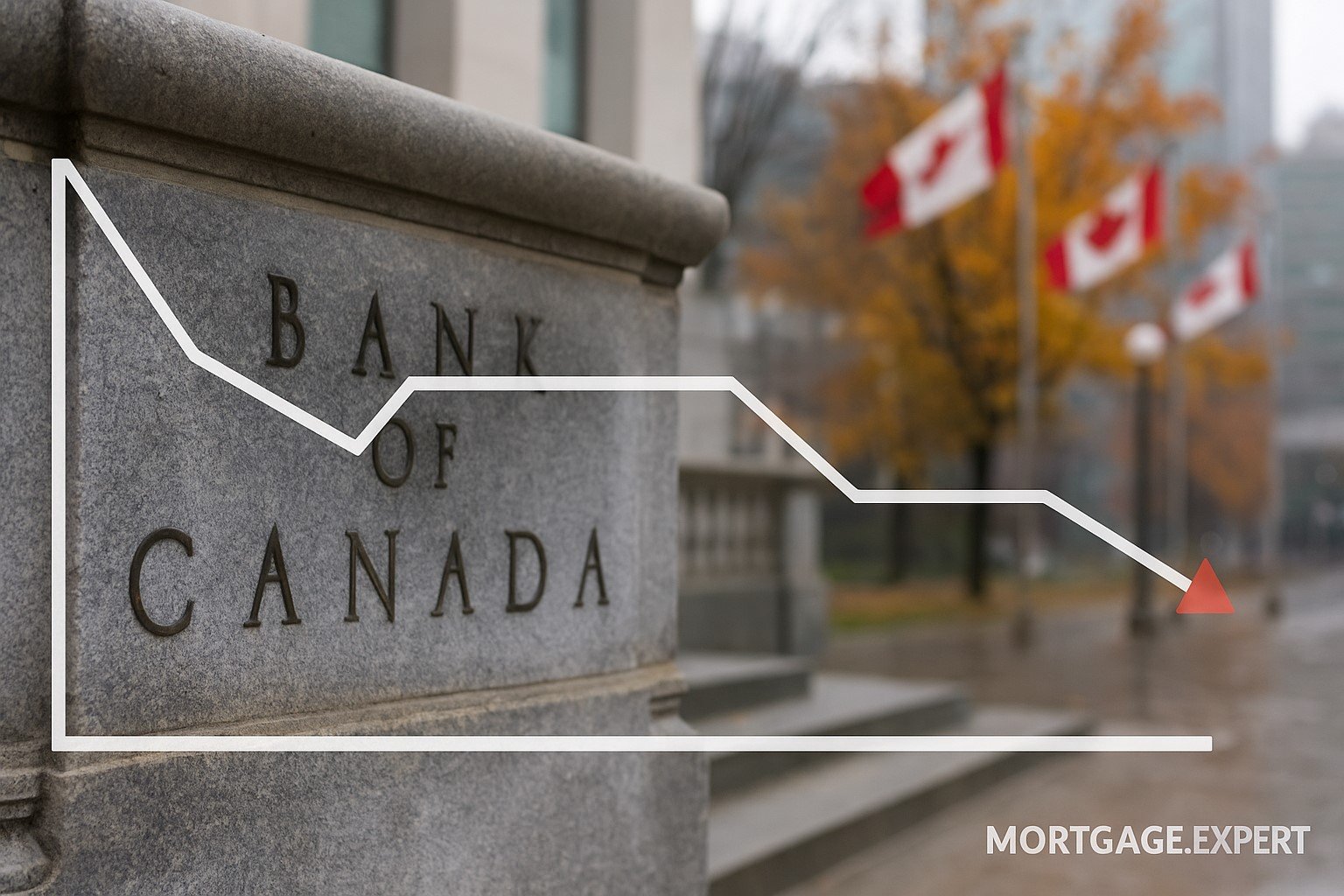

Bank of Canada Cut Once — Is the Easing Cycle Already at Risk?
After one rate cut in September, sticky inflation has tempered hopes for more. What it means for Canadian mortgage borrowers, renewals, and housing
Ottawa | Oct 24, 2025 — The Bank of Canada’s September rate cut marked its first step toward easing in six months. But with inflation proving stickier than hoped, economists are debating whether the cycle has already reached its plateau. For Canadian mortgage borrowers, the implications are direct: the trajectory of interest rates will shape renewal costs, housing demand, and fixed vs. variable strategies well into 2026.
The September Cut: Relief but with Caution
On September 17, 2025, the Bank of Canada trimmed its overnight rate by 25 basis points to 2.50%. The move was widely anticipated, following signs of slowing growth and weaker consumer spending. Floating-rate mortgage holders felt the impact first, with adjustable and variable terms shifting lower by the end of the week.
Yet the relief was modest. For a typical household with a $500,000 variable-rate mortgage, the cut translated to about $100 in monthly savings—helpful, but not transformative. Analysts noted that much of the heavy lifting had already been done in earlier rate cycles, and that this cut was more about signalling flexibility than opening the floodgates.
Inflation Surprise Resets Expectations
Markets had expected further reductions before year-end. But the September inflation print surprised to the upside. Headline CPI rose 2.4% year-over-year, up from 1.9% in August. More importantly, the Bank’s preferred core measures—CPI-trim and CPI-median—remained in the 3.1–3.2% range, well above the 2% target.
This “stickiness” forced forecasters to reset expectations. Where traders once priced in two more cuts by December, odds of even one additional move have now dropped significantly. Bond yields, which underpin fixed mortgage rates, responded by flattening instead of sliding further. The message was clear: while the Bank of Canada has cut once, the next steps are not guaranteed.
Voices Calling for More Relief
Despite sticky inflation, not all economists agree the Bank should pause. CIBC’s Benjamin Tal argued this month that Canada is already in a “per-capita recession.” Adjusted for population growth, GDP has effectively stalled. Tal contends that without deeper monetary easing, Canada risks pushing households into sharper stress just as hundreds of thousands of mortgages come up for renewal.
The BoC itself estimates that 60% of all mortgages will renew in 2025–26, and roughly one-third of households will see payment increases. For Tal and other advocates of more aggressive cuts, the policy priority should be cushioning households from renewal shocks rather than waiting for inflation to grind lower.
Mortgage Market Implications
For borrowers, the debate translates into tough decisions.
- Fixed-rate borrowers: Current national averages sit around 4.69% for 5-year fixed and 4.72% for 3-year fixed. These are higher than many homeowners locked in during 2020–21, meaning renewals will feel painful. But if the BoC is nearing the end of its cutting cycle, fixed rates may not fall much further, limiting the benefit of waiting.
- Variable-rate borrowers: With averages at ~4.42%, variable terms now hold a slight edge. The bet is whether further cuts will come. If the BoC stays cautious, the savings could be limited. But if growth stalls and inflation retreats in 2026, variables may outperform.
- Hybrid strategies: Mortgage brokers report growing interest in “mix-and-match” approaches—splitting principal between fixed and variable portions to balance stability with potential upside.
Housing Market Cooling
CREA data show that national home sales slipped 1.7% in September compared to August, though activity remains above 2024 levels. Price performance diverges by region: Montreal’s benchmark climbed 6.4% y/y, while Toronto fell 5.6% y/y. The uneven market underscores why the BoC faces a delicate balancing act. Too much easing could reignite demand in hot markets, while too little could stall activity in already weak regions.
Investor and Borrower Playbook
The investor takeaway: be data-dependent, like the BoC.
- Watch CPI and labour prints: These will determine the policy path more than any forward guidance.
- Monitor bond yields: Fixed-rate borrowers should keep an eye on the Government of Canada 5-year yield, which directly influences posted rates.
- Stress-test budgets: Assume a “higher-for-longer” scenario even if another cut comes through. Many lenders still qualify borrowers at contract + 2%.
Borrowers weighing renewal options should model multiple paths:
- A 3-year fixed offers stability and flexibility, locking in until 2028 without committing through an uncertain cycle.
- A variable term may save more if the BoC resumes cutting in mid-2026, but comes with risk if inflation forces another pause.
Bottom Line
The Bank of Canada has opened the easing door, but it is not on autopilot. Inflation’s resilience means the September cut may be a one-off for now. Mortgage borrowers are left in a holding pattern: variable terms offer a small discount, but fixed rates still dominate for stability.
For households facing renewals, the decision isn’t about predicting the perfect rate path. It’s about protecting cash flow, testing budgets against surprises, and choosing a strategy that balances peace of mind with potential savings.
Unsure About BoC’s Next Move?
With inflation still sticky, the Bank of Canada’s easing path is uncertain. Find out whether fixed or variable is the right move for your renewal.
Get Personalized Help Now
Clara Desai
Articles: 545Related Posts



Stuck with a Mortgage Decision?
Don’t stress — our team is here to help. Reach out for free, no-obligation guidance.
Contact the Experts