

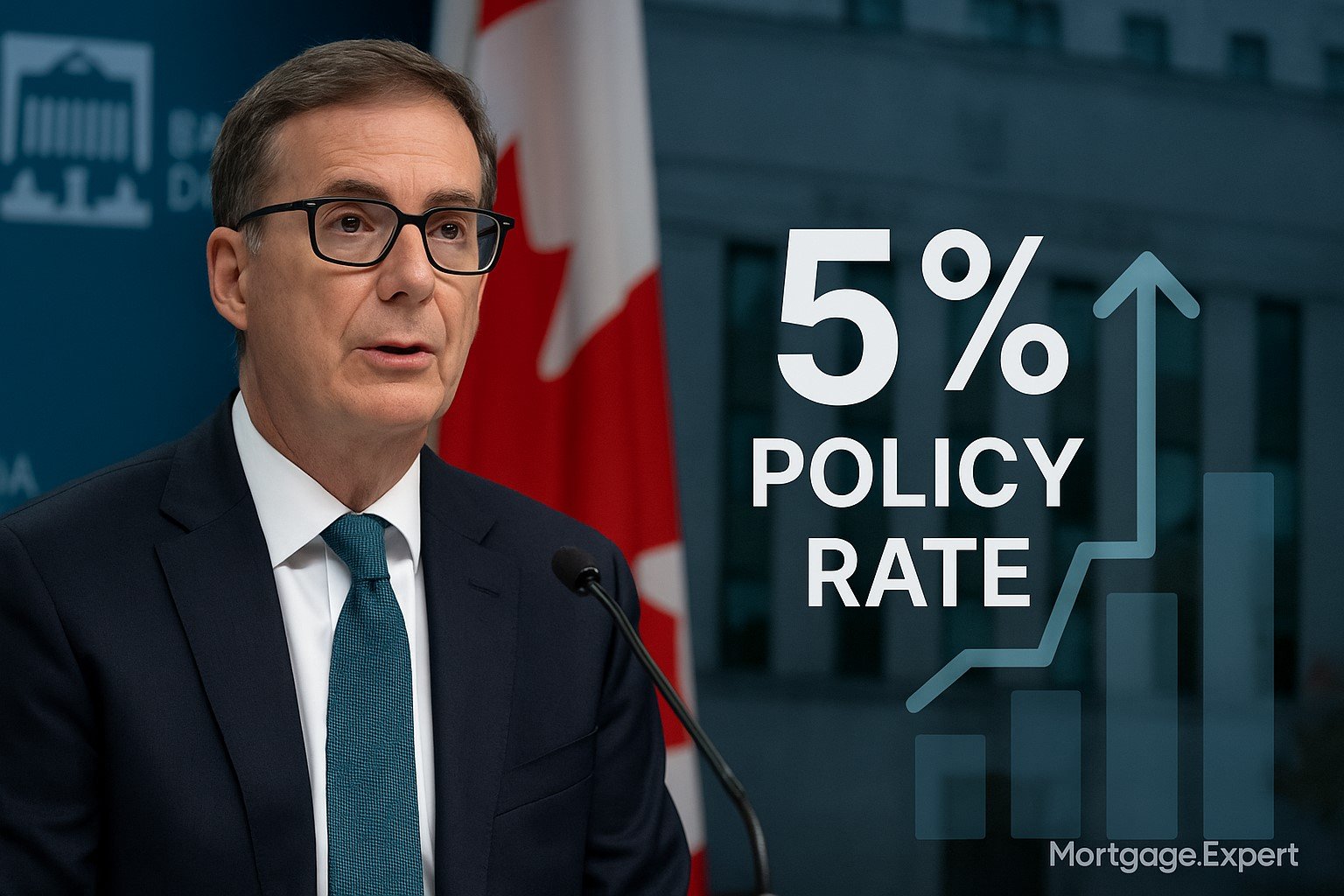

Bank of Canada Holds Policy Rate at 5%, Says ‘Not Even Thinking’ About Cuts
The Bank of Canada kept its key rate steady at 5% on Nov 6 2025. Governor Macklem said he’s “not even thinking” about rate cuts as inflation stays above target.
Toronto | November 7, 2025 — The Bank of Canada has kept its key overnight lending rate unchanged at 5 percent, maintaining its highest policy level in more than two decades. Governor Tiff Macklem reiterated at a press conference that the central bank is “not even thinking” about rate cuts until inflation is firmly under control.
Central Bank’s Tough Stance on Inflation
After a year of volatility in consumer prices, Macklem said inflation remains above the BoC’s 2 percent target despite visible progress in headline readings. Core inflation, which strips out volatile items like fuel and food, has proven sticky — hovering near 3 percent for months.
The governor told reporters that “policy remains restrictive by design” and hinted that the central bank will hold this course as long as needed. “We’ve made good progress, but it’s too early to declare victory,” he said.
Macklem’s tone aligns with that of other central banks worldwide — cautious about easing too quickly. The BoC emphasized that structural pressures, such as global trade disruptions and supply-chain bottlenecks, could slow further disinflation.
Economic Context: A Fragile Balance
Analysts note that the Canadian economy is walking a fine line between cooling inflation and avoiding a deeper slowdown. While GDP growth has softened and unemployment edged higher, consumer demand in housing, energy, and services remains stronger than expected.
Many economists had hoped the Bank would signal a potential rate cut by early 2026, but that now seems less likely. “The message from Governor Macklem was unmistakable: rate cuts are off the table for now,” said one market strategist at a major bank.
Bond yields reacted modestly after the announcement, with the 5-year Government of Canada yield settling near 3.42 %, suggesting that markets still expect gradual easing — but not until mid-2026.
Impact on Mortgage Borrowers
For Canadian homeowners, the rate hold translates to continued pressure on variable-rate mortgages and lines of credit. Variable borrowers will see no immediate relief, as prime rates remain elevated around 7.2 percent.
Fixed-rate borrowers, meanwhile, may find some stability. Because fixed-rate pricing depends more on bond yields, the recent softening in long-term yields means that 5-year fixed mortgage rates have inched down slightly — some insured programs quoting near 3.69 percent for top-tier borrowers.
Still, the gap between posted and “best-available” rates remains wide. Lenders are competing more aggressively for high-credit borrowers, while risk-tiered pricing keeps others above 5 percent.
Housing and Construction Outlook
The Bank’s decision also weighs on housing markets already reeling from limited supply. Elevated financing costs have slowed new construction starts, particularly in Ontario and British Columbia. Developers say higher borrowing costs have delayed projects and thinned margins.
However, Macklem pointed out that keeping inflation in check ultimately benefits affordability. “High inflation erodes the purchasing power of Canadians far more than high interest rates do,” he said, underscoring the Bank’s mandate for long-term stability.
Expert Takeaways
- Short-Term: Mortgage renewals due in 2026 will likely reset at higher effective rates unless inflation moderates.
- Medium-Term: The BoC may hold at 5 percent well into Q1 2026 before cautiously signalling cuts.
- Borrower Strategy: Locking into shorter-term fixed rates (2–3 years) could balance near-term affordability with future flexibility.
The Bank of Canada’s November 6 announcement is a clear message to households and markets alike: no rate cuts yet. With inflation still above target, the central bank prefers patience over premature easing. For mortgage holders, this means a prolonged period of higher borrowing costs — but potentially a more stable inflation outlook ahead.
Facing a mortgage renewal soon?
Our licensed experts can help you compare fixed vs variable options, estimate renewal payments, and plan ahead for 2026.
Talk to a Mortgage Expert
Clara Desai
Articles: 545Related Posts



Stuck with a Mortgage Decision?
Don’t stress — our team is here to help. Reach out for free, no-obligation guidance.
Contact the Experts