

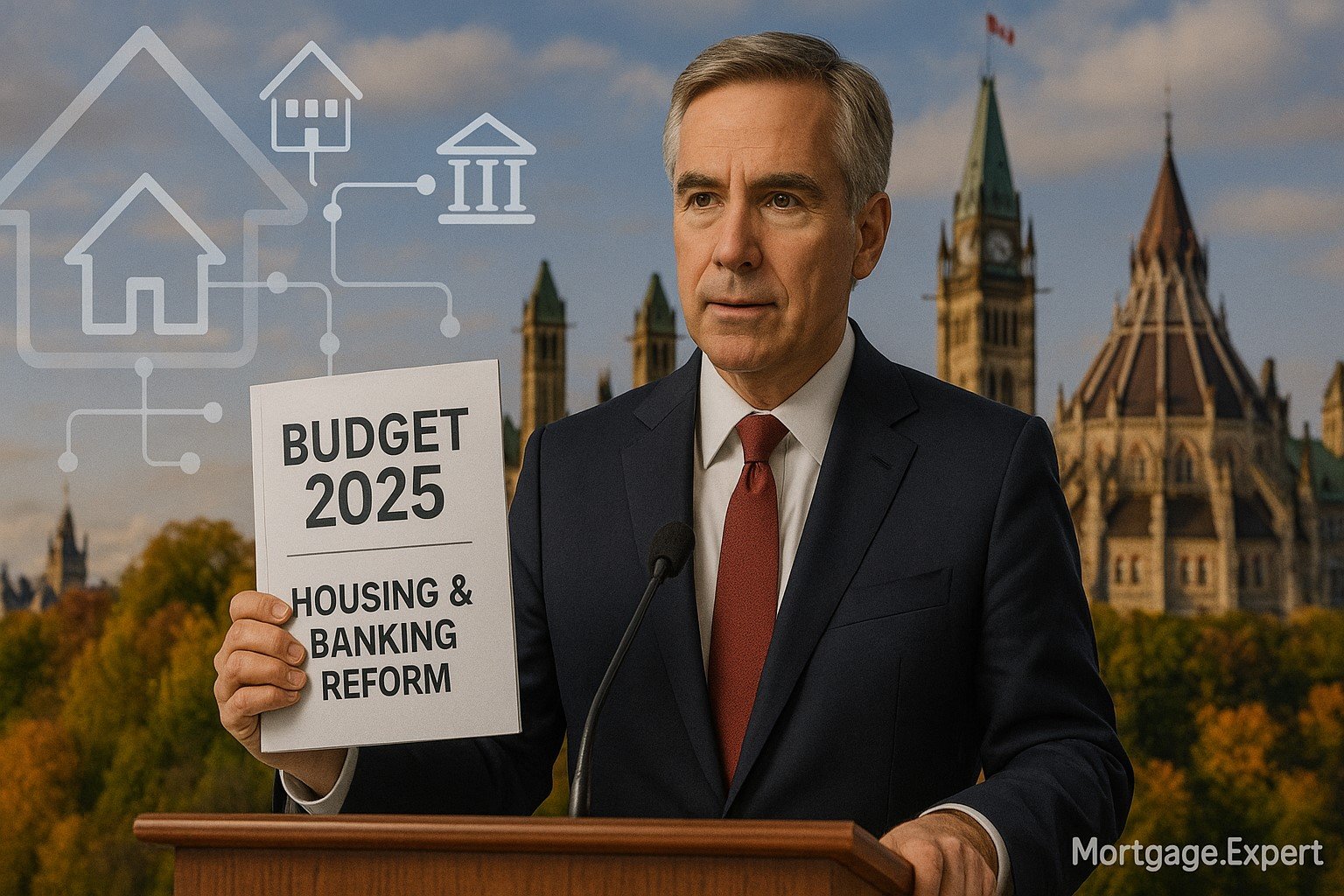

Budget 2025 Puts Housing at the Centre — But Offers Few New Fixes
The Mark Carney government’s Budget 2025 prioritises housing supply and banking competition but introduces few new tools for borrowers. Here’s what it means for rates, renewals and affordability across Canada.
Ottawa | 5-Nov-2025, 11:00 EST —
The newly elected Mark Carney government unveiled its first federal budget on 4 November 2025, promising an ambitious housing and banking-reform agenda. While the headline focus is on affordability and consumer protection, analysts say the plan offers “more continuity than innovation” for mortgage borrowers.
Housing Remains the Political Core
The Budget 2025 document re-confirms Ottawa’s housing ambition — 3.5 million new homes by 2031 — under the National Housing Strategy. To reach this target, the plan extends several existing programs rather than creating new ones:
- Accelerated construction financing: The $55-billion Apartment Construction Loan Program receives an additional $15 billion over six years.
- First Home Savings Account (FHSA) enhancements: A higher annual contribution limit (C$12,000 from C$8,000) and partial portability with RRSPs.
- Tax credit extensions: The Multigenerational Home Renovation Credit and Home Accessibility Credit are renewed through 2030.
While these measures sustain construction activity, economists argue they fall short of structurally easing affordability. Supply constraints, zoning bottlenecks, and elevated land prices still dominate cost dynamics.
Banking and Mortgage Competition
The most market-moving section of the budget may be the new Consumer Banking Competition Act, which aims to make it easier for Canadians to switch lenders:
- No-penalty switching after 36 months on variable-rate loans.
- Mandatory digital portability of mortgage data between lenders.
- Cap on early-renewal fees and clarity on discharge costs.
“This could nudge mortgage rates lower over time,” notes James Laird of Ratehub.ca, “since smaller lenders and credit unions can finally compete on renewals without friction.”
These steps are expected to increase consumer leverage during renewals and pressure large banks to offer more flexible terms. However, implementation depends on coordination between OSFI, the FCAC, and major banks — a process that could take 12–18 months.
Fiscal Context and Economic Impact
Budget 2025 forecasts a deficit of C$19.7 billion (0.7% of GDP), largely driven by housing-related infrastructure spending. The federal government projects real GDP growth of 1.4% in 2026 and inflation averaging 2.1%.
The Bank of Canada’s 2.25% policy rate remains the key variable for mortgage costs. Budget models assume average five-year fixed rates near 5.25% in 2026 — still above the pre-pandemic norm. Officials say that even with rate cuts, renewal pressures will persist for borrowers who took shorter terms in 2022–23.
Infrastructure and Supply-Side Push
Beyond financing incentives, the Budget allocates C$9 billion for urban infrastructure tied to housing density targets. Cities meeting zoning and affordability benchmarks will receive federal matching grants. Analysts say this “carrot approach” may work better than past mandates that failed to unlock land.
Construction industry leaders welcome the funding but warn that labour shortages and high material costs continue to limit build pace. Rising credit costs also discourage developers from starting projects without certainty on pre-sales.
How Borrowers Are Affected
- First-time buyers benefit most from FHSA changes and continued tax credits, potentially saving up to C$1,200 per year.
- Existing borrowers gain from switching freedom and discharge-fee caps, which could cut renewal costs by hundreds of dollars.
- Variable-rate holders see short-term relief as prime rates fall toward 4.45%.
- Fixed-rate borrowers still face higher qualification thresholds under OSFI’s stress test (5.25% or +2%).
Despite the supportive tone, policy continuity means the mortgage market remains a balancing act between regulation, risk, and affordability.
Expert Reactions
Mortgage strategist Leah Zorn called the budget “cautious and credit-positive.” She argues that gradual stimulus beats a sugar rush for housing markets:
“Over-fueling demand would undo the gains of the past two rate cycles. Slow, sustainable support is exactly what mortgage markets need.”
Economist Douglas Porter of BMO Financial Group added that budget timing and rate cuts could combine to produce a “mini housing re-acceleration in late 2026 — but not before renewal pain peaks.”
Budget 2025 keeps housing and mortgage competition front-and-centre without adding major new spending programs. For borrowers, the signal is clear: policy support will remain steady, but no bailouts are coming. Consumers must navigate renewals and affordability with care as the rate environment stabilises.
Planning Your Next Mortgage in 2025?
Our licensed advisors can walk you through Budget 2025’s housing and banking changes — from switching rules to rate-cut timing — so you can lock the right term and protect your budget.
Get Personalized Help Now
Clara Desai
Articles: 545Related Posts



Stuck with a Mortgage Decision?
Don’t stress — our team is here to help. Reach out for free, no-obligation guidance.
Contact the Experts